
Opening and closing kitchen cabinet doors, including drawers and deep drawers, dozens of times a day without even thinking about it is a sign of sound design choices. Is there one precise method? No: whether to choose handles, grip profiles, integrated grips or push-pull mechanisms as kitchen door opening systems depends on the individual project.
THE EXPERT ANSWER
Ideas from Arredo3 experts
Handle, grip profile, integrated grip,
push-pull: when to choose each option.
The opening system is one of the elements with the greatest impact on the everyday kitchen experience: on aesthetics, of course, but also on practicality and safety. Let us look at the options together to support informed choices.
Do kitchen handles still make sense?
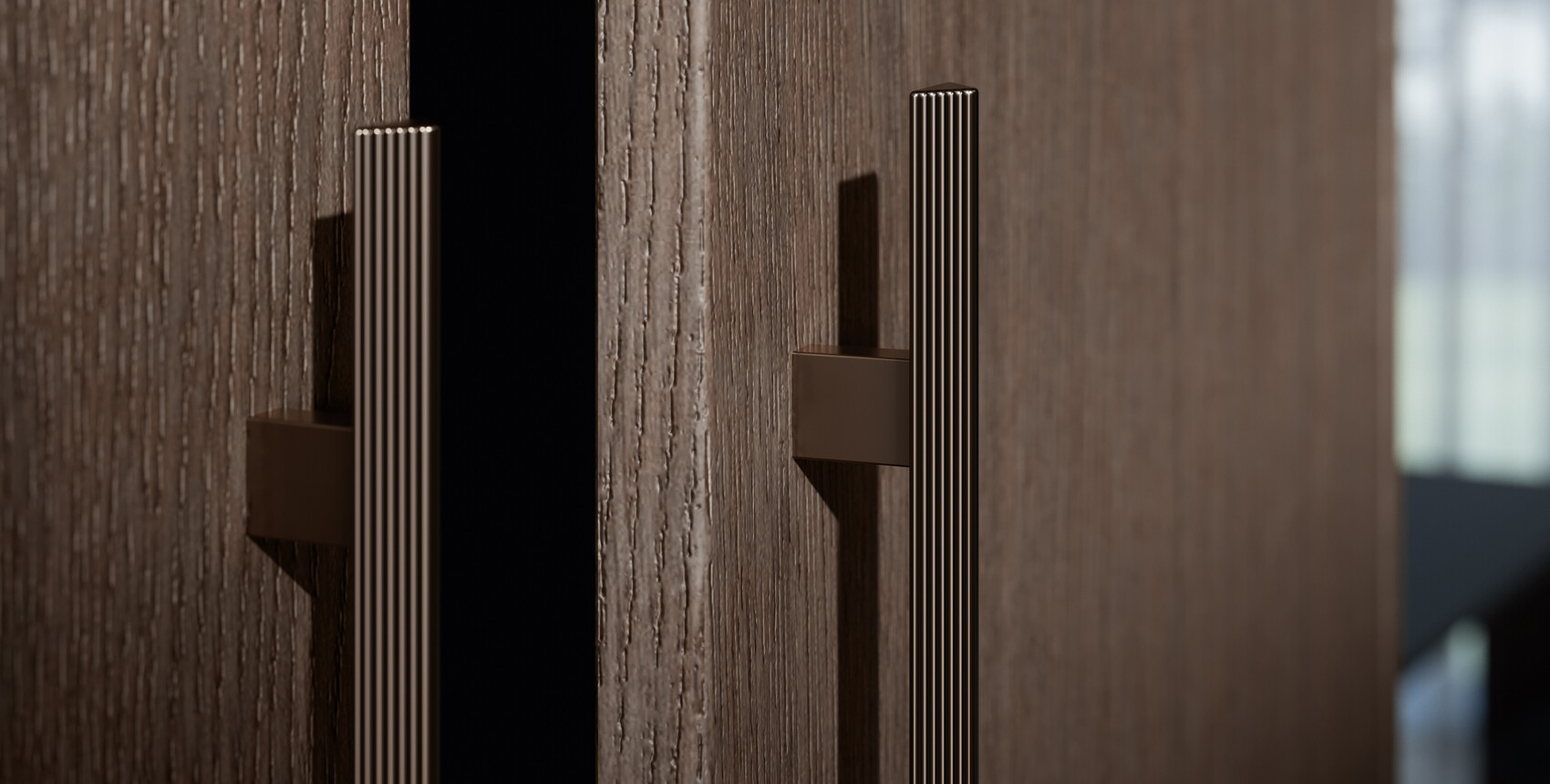
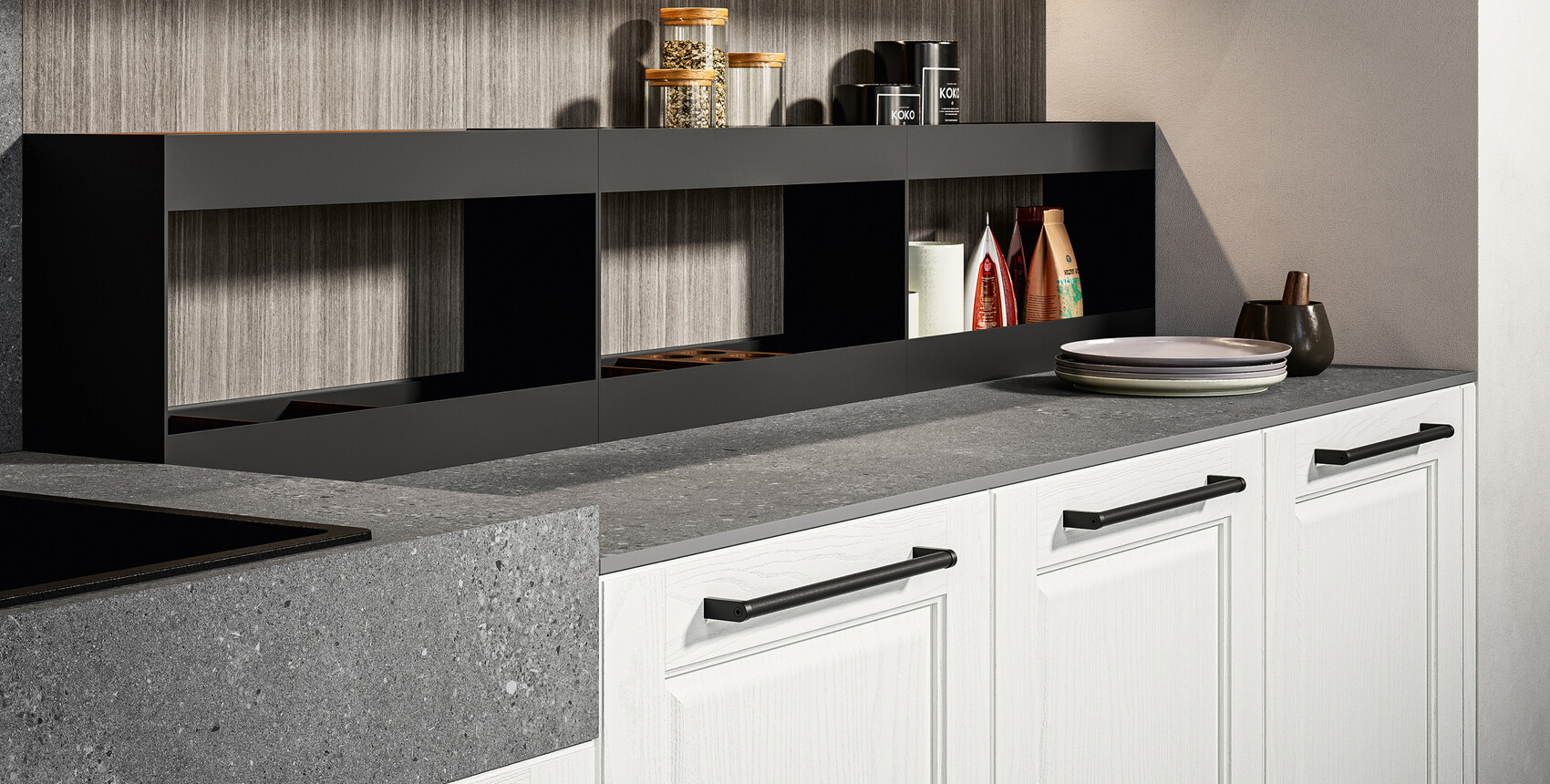
The handle is the most traditional opening system and remains the most widely used. The reason is simple: it provides an immediate, secure grip suitable for every type of cabinet door, including drawers and deep drawers. Today, however, the word ‘handle’ encompasses a whole world of shapes, materials and very different aesthetic personalities. At Arredo3, we offer a wide-ranging selection for different tastes and styles: from bridge handles and knobs - classic, recognisable solutions updated with modern elegance - to the more contemporary lines of the Brera recessed handle, the horizontal body of the Profilo handle and the square shape of the Quadra handle, positioned vertically or horizontally on the door.
When choosing handles, what should you consider besides aesthetics?
One often overlooked factor is the mounting direction. A vertical handle is generally more convenient on large doors because it allows the required force to be applied along the full height of the panel. A horizontal handle, on the other hand, is better suited to base units, drawers and deep drawers. In any case, the handle is the main point of contact between the people using the kitchen and its cabinetry. It is a detail touched every day and one that ultimately defines the character of the entire composition.
What are the advantages of grip profiles in the kitchen?
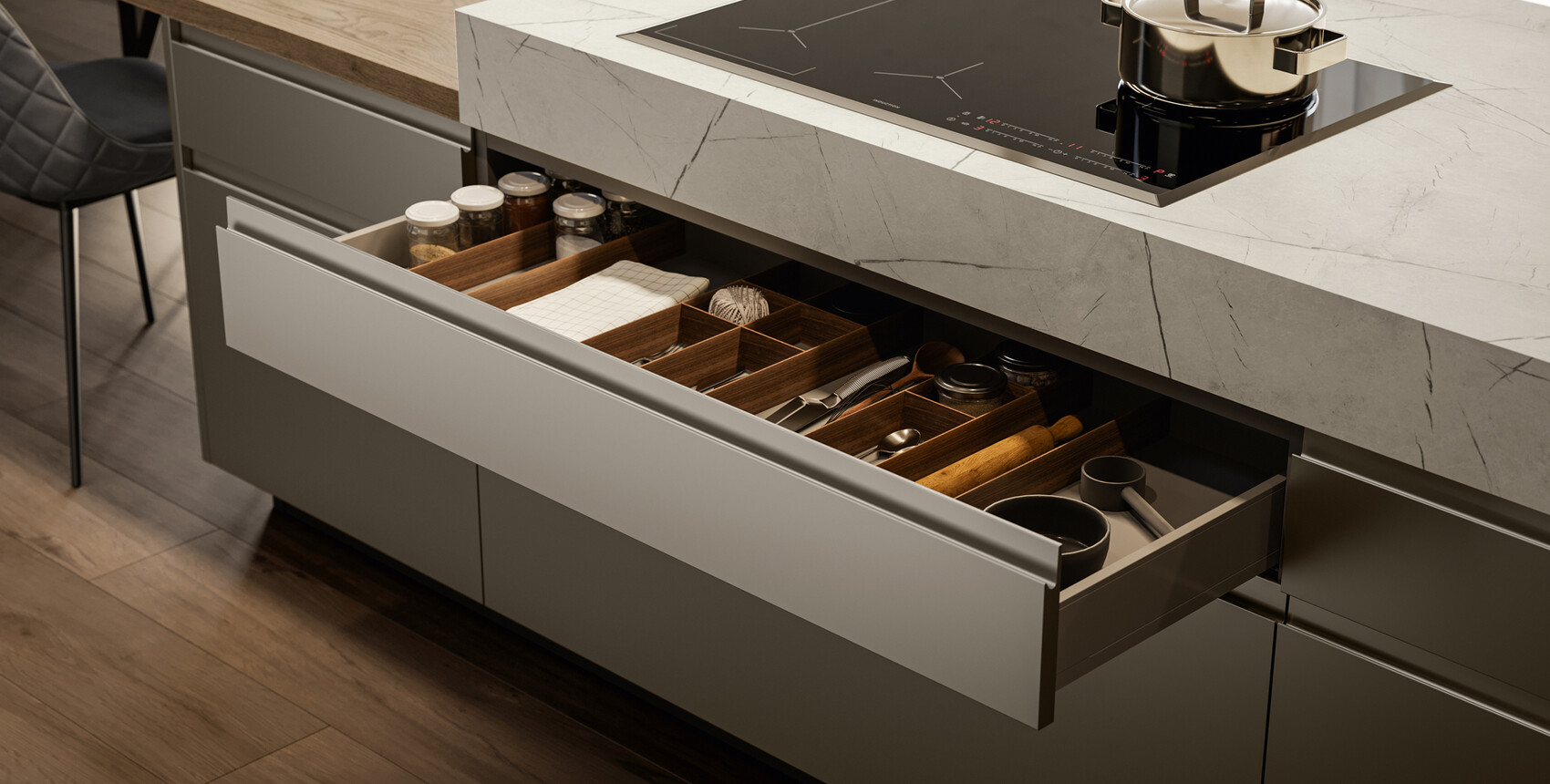
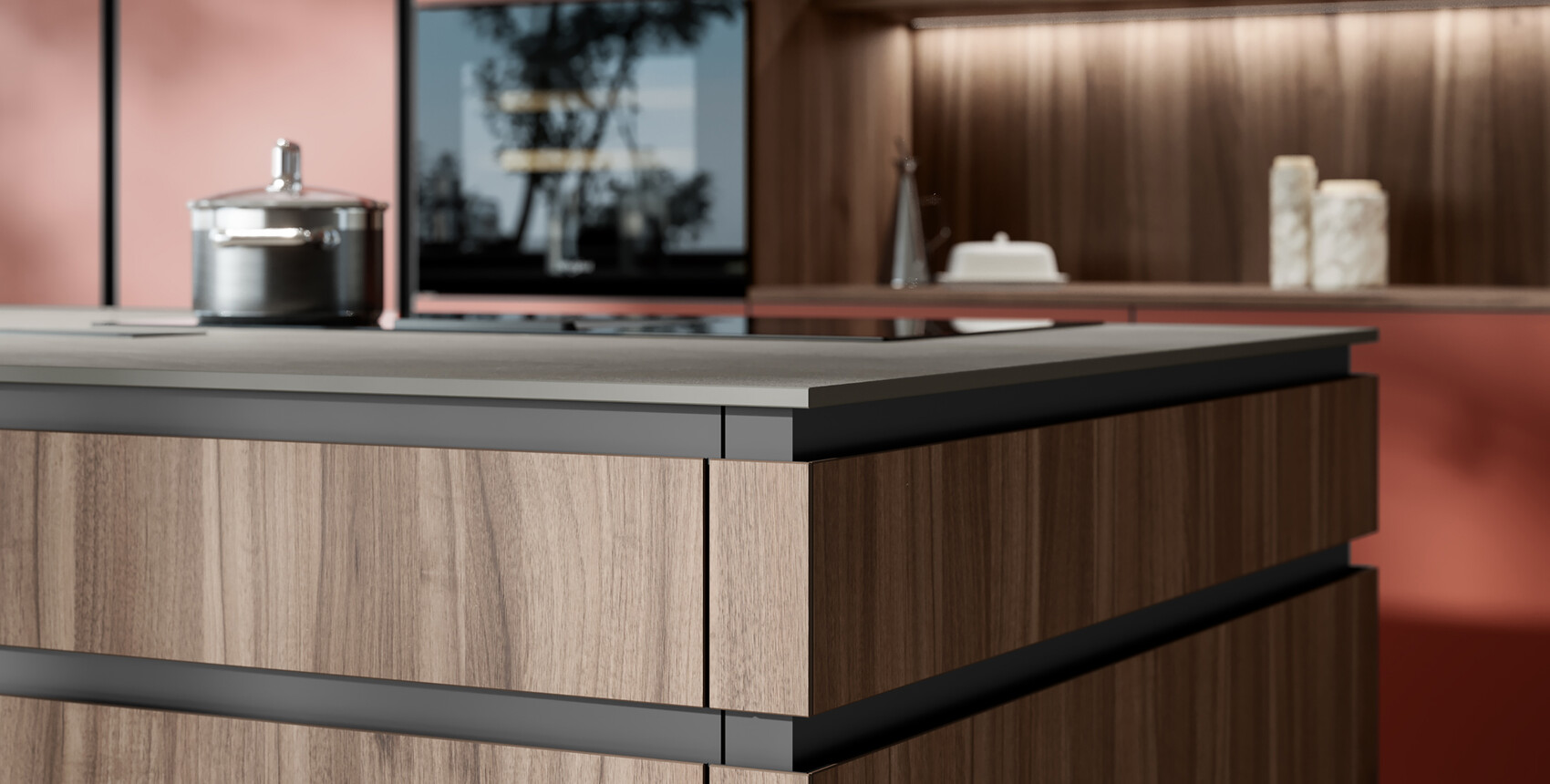
The grip profile is the opening system that has redefined the look of the contemporary kitchen. Instead of a surface-mounted handle, it uses a recess built directly into the cabinet profile, where the fingers can be inserted to open the unit. The result is a continuous surface with no protruding elements, giving the kitchen a clean, streamlined appearance.
In our catalogue, the grip profile system is available in several design variants. It consists of a cabinet carcass that is slightly recessed where the grip profile is required, paired with a suitably prepared door, including drawer and deep-drawer fronts. The options include the standard Retta grip profile - a simple smooth front behind which the fingers can be inserted - the contoured Sinua grip, the peak-shaped K2 handle with subtle linear knurling for a secure grip, the 30° handle with aluminium profiles applied to the doors and slightly angled for easier gripping, and the L-shaped L handle.
What are the advantages of grip profiles in the kitchen?
In general, they are preferable for large doors, where a vertical grip profile ensures elegance and balanced proportions, and for anyone seeking a kitchen with a pared-back aesthetic, in which every unnecessary element is removed in favour of visual clarity. The absence of protrusions also eliminates the risk of knocks and handholds, a practical benefit appreciated especially by families with children.
And what about push-pull, the invisible kitchen opening system?
The push-pull system takes minimalism to its logical extreme: no handle, no grip profile and no visible element. It is ideal for anyone seeking a radically minimalist kitchen and works through a piston integrated into the door. Press it lightly and the mechanism releases, opening the door. It is therefore very convenient when your hands are full, as a touch with an elbow or wrist is enough to open the unit.
However, this system requires careful consideration. It is best reserved for specific areas of the composition, as it is not the ideal choice for large doors or units opened very frequently. We recommend assessing it carefully during the design phase.


The opening system should never be chosen in isolation. It depends on how the kitchen is designed, who uses it and how it is used every day.
Door size. For very tall or wide doors, a vertical grip profile and a full-height handle offer the best balance of aesthetics and ergonomics. Push-pull is better suited to smaller doors.
Available space. In compact settings, every centimetre counts. Grip profiles and push-pull systems have no protruding elements, so they improve freedom of movement and make the kitchen look more spacious.
Children in the home. A grip profile removes protrusions that children could bump into or hold on to. A handle, by contrast, provides a safe, immediate grip for younger users. The choice depends on their age and the family's habits.
Kitchen style. A contemporary, minimalist kitchen works well with a grip profile or push-pull system, while a warmer or more classic design can be enhanced by a statement handle. There are no absolute rules, however: we recommend maintaining consistency throughout the project.
Everyday ergonomics. Anyone who cooks frequently benefits from a direct, secure grip such as a handle. Those who prioritise aesthetics and use the kitchen less intensively may prefer a grip profile or push-pull system.
If we really had to choose: handle or grip profile?
It depends on the style you want to achieve and on practical needs. A handle is more immediate to use and comes in a very wide range of designs; a grip profile creates a cleaner, more streamlined look. For large doors, both solutions work well when used vertically. We recommend evaluating them within the overall design rather than as an isolated choice.
Can several opening systems be combined in the same kitchen?
Absolutely - and it is a very common solution. The important point is to design the combination coherently: different systems can coexist harmoniously if they share the same aesthetic language through material, colour or geometry.
Is a handleless kitchen really practical?
Yes, if it is well designed. Grip profile and push-pull systems are now mature and thoroughly tested. The absence of handles also makes surfaces easier to clean by eliminating the gaps between a handle and the front of a base unit, wall unit, tall unit, drawer or deep drawer, where dirt can collect. As already noted, it is also safer for children.
Which opening system is best for high wall units?
For the highest kitchen wall units, the so-called top boxes above tall units, the most ergonomic solution is push-pull. It is also a good option for wall units in general because no grip is required: a simple press is enough. The alternative is a grip recess formed along the bottom edge of the wall unit. We do not recommend a handle here, as gripping it from above makes the movement less ergonomic.
In a small kitchen, which opening system saves the most space?
In a compact space, systems with no protrusions, such as grip profiles or push-pull mechanisms, are preferable because they do not take up extra room and give the kitchen a more continuous, orderly appearance.
Why make an all-or-nothing choice between handles and grip profiles in the kitchen? Mixed solutions - using several opening systems in the same kitchen - work extremely well: grip profiles for base units, handles for tall units and push-pull mechanisms for wall units. The result will be harmonious if the overall design language is consistent.


Would you like help choosing the opening systems for your kitchen doors?
As should now be clear, the opening system is not a detail to decide at the end of the process. The right choice begins with a well-designed kitchen. It is an integral part of the project and influences aesthetics, functionality and everyday comfort just as much as the choice of materials or unit layout.
Our advice is therefore always the same: consult a professional, explain how you live in and use the kitchen and share your tastes with someone who can also become thoroughly familiar with the space to be furnished, such as an authorised Arredo3 retailer. Shall we start a project together?


